



Wheel Loaders vs. Skid Steers: Choosing the Best Loader for Agricultural Use
Premise
Material handling is the operational backbone of modern agriculture. Whether moving thousands of tons of silage, loading high-sided fertilizer spreaders, clearing packed manure from tight livestock pens, or stacking high-density square bales, a farm’s productivity depends directly on the speed, lifting strength, and operational cost of its loading machinery.
Traditionally, the compact skid steer loader served as the default, all-purpose workhorse on North American farms. However, the rise of compact and mid-sized articulated wheel loaders—as well as agile compact track loaders (CTLs)—has introduced a serious alternative. Choosing between a wheel loader and a skid steer is not merely a matter of brand preference; it is a critical capital allocation decision that dictates cycle times, fuel expenses, tire wear, operator fatigue, and long-term return on investment (ROI). This article details the ten core operational criteria farm managers must evaluate to determine which loader platform best serves their agricultural operation.
Introduction
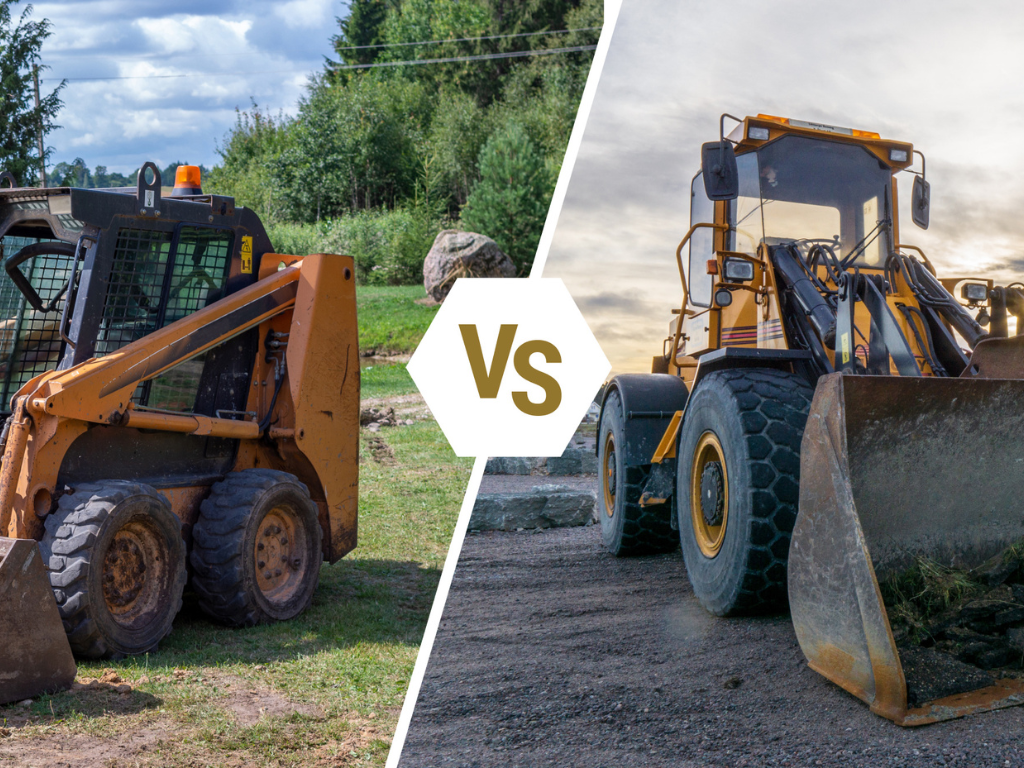
Agricultural operations handle diverse materials under demanding timelines. From grain elevators and dairy feed alleys to commercial poultry barns and mixed-livestock yards, farm chores require heavy-duty lifting, fast transit, and dependable ground engagement. Skid steer loaders, with their ultra-compact rigid frames and counter-rotating zero-turn maneuverability, built their legacy on versatility and access in confined quarters.
At the same time, articulated wheel loaders are becoming increasingly popular across agricultural sectors. By pivoting at a central articulated joint rather than skidding tires across the ground, wheel loaders deliver higher travel speeds, increased reach, lower surface disturbance, and substantially better fuel efficiency.
Evaluating both machine designs across real-world farming applications clarifies the strengths of each platform. Below is a detailed, ten-point comparative guide examining lift mechanics, ground impact, visibility, attachment compatibility, and total cost of ownership to help select the best machine for your farm.
1. Maneuverability and Turning Dynamics
The fundamental distinction between skid steers and wheel loaders lies in how they steer. A skid steer operates on a rigid chassis, turning by driving the left and right wheels or tracks at different speeds or in opposing directions (counter-rotation), allowing it to spin within its own physical footprint. An articulated wheel loader turns by pivoting its front and rear chassis sections around a heavy-duty central hinge, rolling its wheels smoothly along an arc. In tight barns, poultry houses, and indoor alleyways, a skid steer can pivot 360 degrees on the spot, whereas an articulated wheel loader requires a defined turning radius, though its oscillating articulation still provides agility around yard corners and silage bunks.
- Operational Highlights: Skid steers excel inside tight structures with 90-degree corners, dead-end alleys, and narrow gates; wheel loaders require wider turning radiuses but track cleanly around obstacles, preventing side-swiping accidents caused by tail swing when working along feed troughs or bunk walls.
2. Ground Disturbance, Surface Wear, and Tire Longevity
Because skid steers steer by sliding or skidding rubber tires across the operating surface, they exert high lateral friction. On hard concrete pads, asphalt barnyards, and paved silage bunks, this scrubbing action accelerates tire wear, often requiring tire replacement every few hundred operating hours. On soft turf, pasture, or mud, skidding tears up vegetation and creates deep ruts. In contrast, an articulated wheel loader rolls its tires forward naturally through turns, eliminating scrubbing friction, extending tire lifespans, and protecting finished surfaces.
- Operational Highlights: Wheel loader tires frequently last three to five times longer than standard skid steer tires under identical concrete yard conditions; articulated loaders minimize paddock rutting, preserve asphalt sealants, and keep unpaved gravel roads smooth without gouging ruts during turns.
3. Lift Capacity, Dumping Reach, and Loading Geometry
Loading high-sided commodity trailers, feed mixer wagons (TMRs), and tall manure spreaders demands substantial hinge-pin height and forward dump clearance. Wheel loaders are engineered with high-mounted loader towers and elongated Z-bar or parallel linkage arms that provide higher reach and greater forward dumping distances at maximum height. Skid steers—available in radial or vertical lift configurations—are effective for lower-to-mid-height tasks, but vertical lift models can lose forward reach when fully extended, making it difficult to center loads into 12-to-14-foot high-capacity grain and silage trailers.
- Operational Highlights: Compact wheel loaders typically achieve hinge-pin heights ranging from 10 to over 13 feet with strong forward dump reach; skid steers can struggle to clear the top rim of high-sided silage trailers without pulling dangerously close to the trailer wall.
4. Cycle Times, Travel Speeds, and Material Transport Over Distance
Farm tasks often require transporting heavy loads across large yards, between distant outbuildings, or down field roads. Skid steers are engineered for close-quarters loading and typically have travel speeds limited to 7 to 12 mph (11 to 19 km/h), making long runs slow and bumpy. Articulated wheel loaders feature larger diameter tires and multi-speed hydrostatic or powershift transmissions that achieve road speeds of 18 to 25+ mph (30 to 40+ km/h), cutting cycle times when moving bulk silage, loading field spreaders, or hauling round bales across pastures.
- Operational Highlights: Wheel loaders move bulk materials faster between storage bunkers and distant livestock barns; increased road travel speeds eliminate the need for equipment transport trailers when moving between adjacent farm plots.
5. Fuel Efficiency and Long-Term Operational Economics
Under continuous heavy loading, fuel consumption represents a major operating cost. Articulated wheel loaders require less horsepower to turn and propel forward because they do not fight the mechanical resistance of skidding tires across the ground. A wheel loader can often match or exceed the lifting output of a larger skid steer while using a smaller, more fuel-efficient engine operating at lower RPMs. Skid steers consume extra fuel during every steering correction due to side-drag resistance, especially when loaded on high-traction surfaces.
- Operational Highlights: Articulated wheel loaders regularly demonstrate a 20% to 35% reduction in hourly fuel consumption compared to similarly rated skid steers performing repetitive loading cycles; lower operating RPMs also reduce engine wear and extend service intervals for hydraulic and engine oils.
6. Operator Visibility, Sightlines, and Safety
Clear visibility directly impacts workplace safety, cycle speed, and equipment damage on busy family farms and commercial operations. Skid steer operators sit low between side lift arms and structural towers, which restricts sightlines to the rear quarters and front tires. Wheel loaders position the operator in an elevated cab mounted above the chassis, providing true 360-degree panoramic sightlines over the engine hood, loader arms, and front attachment corners.
- Operational Highlights: The elevated vantage point of a wheel loader provides clear sightlines over feed bunk rims, livestock fencing, and trailer edges; skid steer operators rely heavily on backup cameras and mirrors due to structural blind spots created by rear cooling towers and side loader frames.
7. Cab Ergonomics, Ingress/Egress, and Operator Fatigue
Agricultural work requires operators to enter and exit the cab frequently to open gates, hitch trailers, check bale wrapping, or inspect feed quality. Skid steers require climbing over the front attachment and underneath raised loader arms—a safety concern if the boom is not mechanically locked out—or navigating tight side doors on specialized single-arm models. Wheel loaders feature traditional automotive-style side doors with clear stair steps, allowing safe, effortless entry and exit regardless of where the loader arms are positioned.
- Operational Highlights: Side-entry wheel loader cabs eliminate the hazard of climbing over muddy, manure-coated buckets and cutting attachments; spacious wheel loader cabs offer superior suspension seating, larger interior volume, and reduced noise and vibration levels, lowering operator fatigue during long shifts.
8. Attachment Versatility and Hydraulic Power Output
Both machine categories support diverse work tools, but skid steers hold a traditional advantage in attachment variety and high-flow hydraulic setups. The skid steer universal quick-attach system (SSQA) is the industry standard for attachments like hydraulic post-hole augers, high-flow cold planers, bale processors, brush cutters, and vibratory rollers. While compact wheel loaders also utilize skid steer adapter plates and auxiliary hydraulics, specialized high-flow skid steers remain the top choice for running continuous, high-draw hydraulic attachments.
- Operational Highlights: Skid steers feature hydraulic output configurations up to 40+ GPM (gallons per minute) at high operating pressures, powering high-demand tools like forestry mulchers and snow blowers; wheel loaders excel with high-capacity bulk buckets, silage defacers, pallet forks, and heavy-duty manure grabs.
9. Traction, Flotation, and Performance on Mud and Slopes
Field conditions in early spring and late autumn can turn farm lanes and feedlots into mud. Skid steers with standard tires can struggle in deep mud, though switching to a Compact Track Loader (CTL) provides excellent flotation and traction on soft ground. Articulated wheel loaders utilize large-diameter agricultural flotation tires, front-and-rear differential locks, and frame oscillation that keeps all four drive wheels on the ground across uneven, rutted terrain, delivering steady tractive effort without churning deep ruts.
- Operational Highlights: Wheel loaders equipped with locking differentials provide strong pushing power into heavy, packed manure pits and ensiled grain piles without spinning out; tracked skid steers provide low ground pressure on delicate lawns and saturated soils, though tracked undercarriages carry higher maintenance costs.
10. Acquisition Capital vs. Total Cost of Ownership (TCO)
Initial equipment purchase price often guides machinery selection, but total lifecycle cost reveals the true investment picture. A compact skid steer typically carries a lower upfront purchase price than a comparable articulated wheel loader. However, when factoring in the wheel loader’s lower fuel consumption, longer tire lifespan, reduced hydraulic strain, and higher residual resale value on agricultural markets, the articulated wheel loader often yields a lower total cost per operating hour over a five-to-ten-year lifecycle.
- Operational Highlights: Skid steers offer lower entry costs for farms requiring occasional material handling (under 300 to 500 hours annually); high-hour operations (700+ hours annually on dairy, feedlot, or commercial poultry farms) recover the wheel loader’s purchase premium through fuel savings, reduced tire replacement costs, and higher resale values.
Conclusion
Ultimately, protecting your farm’s bottom line is about making smart, data-driven decisions on where every dollar of capital is deployed. While new tractors offer visual appeal and fresh factory warranties, the math shows that the true cost of immediate depreciation, large capital outlays, and high interest expenses can put a serious strain on an operation’s seasonal financial health. Choosing premier used tractors allows agribusinesses to break free from this cycle, capturing exceptional mechanical capacity while keeping their cash reserves completely intact.
By preserving your liquid cash flow, you gain the financial freedom to make aggressive investments in your core revenue-generating assets: high-yielding seeds, precision fertilizers, and strategic land expansion. Partnering with a trusted, long-standing local dealership ensures that your pre-owned machinery investment is fully verified, thoroughly inspected, and completely backed by the expert parts and service lines required to keep your operation highly profitable and efficient for seasons to come.
Protect Your Farm’s Bottom Line with Oneida New Holland
Ready to maximize your operational margins and secure a high-value, field-ready tractor? Whether you are looking to add a dependable utility workhorse or expand your fleet with a fully inspected, high-horsepower pre-owned tractor, the expert team at Oneida New Holland is here to help you solve your fleet equation. We are proud to provide high-quality used inventory backed by the professional parts, service, and financing options needed to support your business.
Oneida Caledonia
- Address: 634 Fourth Line, Caledonia, ON, N3W2B3
- Call: 905-765-5011
- Website: https://oneidanewholland.com/
Oneida Niagara
- Address: 1410 Fourth Avenue, St. Catharines, ON, L2S 0B8
- Call: (905) 688-5160
- Website: https://oneidanewholland.com/
Frequently Asked Questions (FAQ)
Q1. Can an articulated wheel loader use skid steer attachments?
A1. Yes. Many modern compact and agricultural wheel loaders come factory-equipped with—or can be retrofitted with—a universal skid steer quick-attach (SSQA) plate and auxiliary hydraulic lines. This allows operators to share standard-flow attachments like pallet forks, bale spears, augers, and light-material buckets between both machines.
Q2. Why do wheel loader tires last longer on concrete than skid steer tires?
A2. Skid steers lack traditional steering mechanisms; to turn, the machine locks or reverses the wheels on one side, dragging and skidding rubber across abrasive concrete under the machine’s full weight. Articulated wheel loaders turn by pivoting their frame at a central hinge, allowing all four tires to roll naturally through the turn, eliminating scrubbing friction and significantly extending tread life.
Q3. Which machine is safer for loading high-sided manure spreaders and feed mixer wagons?
A3. Articulated wheel loaders generally offer a safety advantage for high loading tasks. Their higher hinge-pin placement, long Z-bar linkage reach, and elevated cab position give operators a clear view down into the wagon or spreader, preventing costly rim impacts and ensuring even load distribution without driving dangerously close to the trailer wall.
Q4. When does a Skid Steer or Compact Track Loader (CTL) make more sense than a Wheel Loader?
A4. A skid steer or CTL is the better choice when working inside tight confinement barns with narrow doorways, cleaning out low-ceiling poultry sheds, operating on steep dirt inclines requiring tracked flotation, or using specialized high-flow hydraulic attachments like forestry mulchers, cold planers, and heavy-duty brush mowers.
Q5. How does fuel consumption compare between the two machines?
A5. In head-to-head testing across material-handling tasks, articulated wheel loaders often consume 20% to 35% less fuel than similarly sized skid steers. Because wheel loaders roll freely through turns instead of dragging tires against ground resistance, their engines do not encounter high parasitic torque loads during routine steering maneuvers.