



Beyond the Mower: Essential Attachments for Your Compact Tractor
The purchase of a compact tractor is often the single most significant investment a property owner or small-scale farmer will make. However, many owners fall into the trap of viewing their machine as little more than a high-powered lawnmower. While a mid-mount mower or a brush hog is essential for turf management, the true value of a compact tractor lies in its versatility. The “Swiss Army Knife” of the equipment world, a compact tractor is only as capable as the implements hanging off its three-point hitch or front-end loader. By diversifying your attachment arsenal, you transition from a seasonal mower to a year-round site manager, capable of handling everything from sub-surface drainage to heavy winter snow removal.
The premise of this guide is simple: to maximize your Return on Investment (ROI), your tractor should never have an “off-season.” Whether you are managing a hobby farm in Caledonia or a commercial landscaping operation, understanding the mechanics and applications of specialized attachments is the key to efficiency. This article explores ten essential categories of attachments—ranging from soil health tools like aerators to winter essentials like snow blowers—that will transform your compact tractor into a multi-purpose workhorse.
1. Core Aerators: The Secret to Professional Turf Health
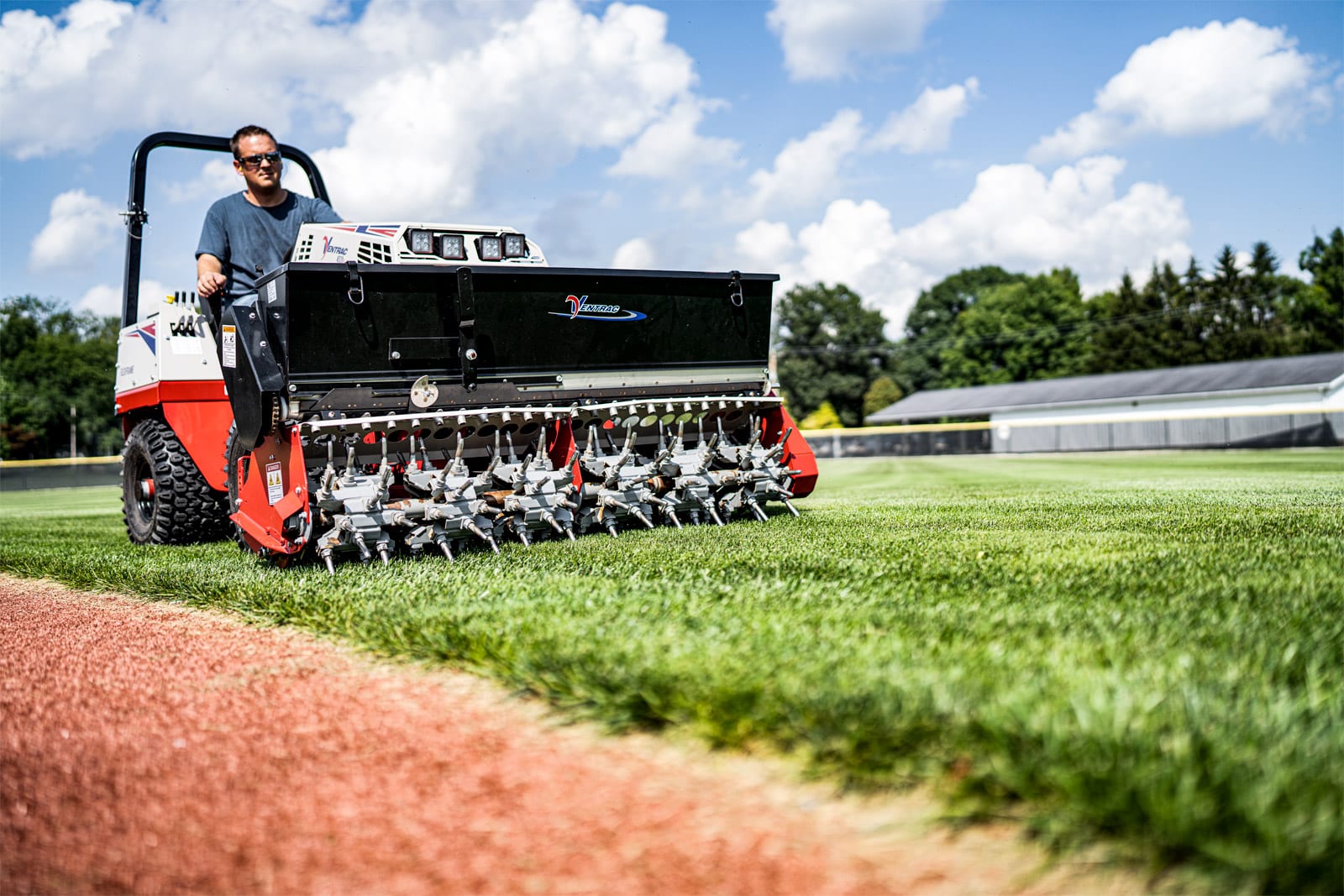
Soil compaction is the silent killer of healthy lawns and pastures. Over time, foot traffic, equipment, and even heavy rainfall compress the soil, squeezing out the air and water pockets that roots need to thrive. A tractor-mounted core aerator uses hollow tines to pull small “plugs” of soil from the ground, allowing nutrients, oxygen, and moisture to penetrate deep into the root zone. Unlike “spike” aerators, which can actually increase compaction by pushing soil aside, a true core aerator removes material, creating the physical space necessary for root expansion and vigorous growth.
- Tine Depth and Density: Most commercial-grade aerators allow for depth adjustments up to 4 inches, ensuring you reach the critical root layer.
- Hitch Compatibility: These are typically Category 1 three-point hitch implements that utilize the tractor’s weight to ensure consistent penetration in hard clay soils.
- Best Time for Use: Ideally used during peak growing seasons (spring or fall) when the grass can quickly recover and fill the holes.
- Weight Brackets: Many units feature integrated weight trays where you can add suitcase weights or cinder blocks for better performance in bone-dry conditions.
2. Rotary Tillers: Preparing the Perfect Seedbed
For the gardener or small farmer, a rotary tiller is the ultimate labor-saving device. Breaking new ground with a shovel is backbreaking; using a walk-behind tiller is exhausting. A tractor-mounted, PTO-driven rotary tiller uses the machine’s horsepower to pulverize soil clods, incorporate organic matter, and level the planting surface in a single pass. These units are designed with heavy-duty tines and oil-bath gearboxes to ensure they can handle rocky or high-clay soils without failing.
- Slip Clutch Protection: High-quality tillers feature a slip clutch instead of a shear pin to protect the tractor’s PTO drivetrain when the tines strike a large rock or root.
- Adjustable Skid Shoes: These allow the operator to control the tilling depth precisely, preventing the tines from going too deep and hitting the subsoil.
- Clevis Hitch Design: Provides a secure connection that minimizes vibration and ensures the tiller tracks straight behind the tractor.
- Forward vs. Reverse Rotation: Some models offer reverse-rotating tines, which are more aggressive for breaking up “virgin” sod or hard-packed earth.
3. Box Blades: The Foundation of Site Grading
If you have a gravel driveway or uneven paddocks, a box blade is perhaps the most essential “non-mowing” tool you can own. A box blade consists of a heavy metal box with “scarifier” teeth at the front and scraping blades at the rear. It is designed to “cut” high spots, “carry” material in the box, and “fill” low spots simultaneously. It is the gold standard for maintaining a smooth, well-drained driveway and is far more effective than a simple rear blade for moving significant amounts of earth or gravel.
- Adjustable Scarifier Shanks: These heavy-duty teeth can be lowered to break up hard-packed gravel or “ripped” soil before the blade levels it.
- Dual Cutting Edges: Most box blades feature a reversible and replaceable cutting edge on both the front and back of the box for maximum longevity.
- Weight for Traction: The sheer weight of a box blade helps keep the tractor’s rear tires planted, improving traction during heavy pulling.
- Finish Grading: By shortening the top link of your three-point hitch, you can tilt the box to “feather” material out, creating a glass-smooth finish.
4. Front-End Loader Pallet Forks: Versatility Beyond the Bucket
The standard bucket that comes with your loader is great for moving dirt, but it is a poor tool for moving almost anything else. Pallet forks are often cited by tractor owners as their most-used attachment. From moving stacked firewood and bulk bags of seed to lifting heavy equipment off a delivery truck, pallet forks turn your tractor into a mobile forklift. Because they offer a clear view of the “tips,” they allow for much more precise lifting and placement than a bulky bucket.
- Adjustable Width: Tines can be slid along a rail to accommodate different pallet sizes or to pick up oddly shaped items like logs or brush.
- Lift Capacity: Always check your tractor’s loader lift capacity; remember that the weight of the forks themselves subtracts from the total payload.
- Safety Features: High-quality forks include a “headache rack” to prevent items from rolling back onto the loader arms or the operator.
- Debris Cleanup: Forks are surprisingly effective at “skimming” the ground to pick up piles of branches or fence posts without scooping up excessive amounts of dirt.
5. Rear-Mounted Snow Blowers: Master of the Canadian Winter
In regions like Caledonia, winter isn’t just a season; it’s a logistical challenge. While a snow blade or a bucket can move snow, they eventually run out of places to “push” it, creating massive banks that block visibility and narrow your driveway. A PTO-driven, rear-mounted snow blower solves this by throwing the snow 30 to 50 feet away. These two-stage blowers use an auger to pull in the snow and a high-speed fan (impeller) to launch it through a chute, ensuring your driveway stays wide and clear all winter long.
- Two-Stage Design: The first stage breaks up ice and packed snow, while the second stage provides the “oomph” to clear the area.
- Manual or Hydraulic Chute: Hydraulic chute rotation and deflector adjustment allow you to change the direction of the snow without leaving the tractor seat.
- Shear Bolt Protection: Designed to break if the auger hits a solid object (like a frozen newspaper or a rock), protecting the expensive gearbox.
- Rear-Facing Operation: While it requires looking backward, rear-mount units are generally more affordable and easier to attach than complex front-PTO systems.
6. Post Hole Diggers: Fencing Made Easy
Setting fence posts by hand is a grueling task that can take days for a single pasture. A tractor-mounted post hole digger (often called a “power auger”) uses the tractor’s PTO to drive a heavy-duty screw into the ground with hundreds of pounds of torque. This attachment is indispensable for fencing, planting trees, or setting footings for a new deck or shed. The hydraulic down-pressure (on some models) and the sheer weight of the boom make short work of even the most stubborn clay.
- Auger Bit Variety: Bits typically range from 6 inches (for T-posts) to 24 inches (for large corner posts or tree saplings).
- Replaceable Teeth: The cutting edges at the tip of the auger can be replaced when they become dull, extending the life of the main bit.
- Safety Shields: Modern augers include shields around the PTO shaft and the top of the gearhead to prevent entanglement.
- Storage Stands: Because they are awkward to handle, many owners use a dedicated stand to make hooking and unhooking the digger a one-person job.
7. Landscape Rakes: The Finishing Touch
A landscape rake (or “York rake”) is the tool you reach for when the heavy earthmoving is done and it’s time for the “grooming” phase. Featuring a row of flexible spring-steel tines, this attachment is perfect for raking rocks, roots, and debris out of a seedbed. It is also an excellent tool for “fluffing” gravel driveways and removing thatch from large turf areas. Its ability to angle the rake allows you to windrow debris to one side for easy pickup.
- 360-Degree Rotation: Most rakes can be rotated completely around, allowing you to “push” material into piles rather than just pulling it.
- Tine Spacing: Designed to let soil through while catching stones and debris larger than an inch or two.
- Optional Gauge Wheels: Adding wheels to the back of the rake prevents it from “diving” into soft spots, ensuring a perfectly level finish.
- Spring Steel Tines: The flexibility of the tines allows them to “bounce” over solid obstructions like large boulders or stumps without snapping.
8. Wood Chippers: Turning Waste into Resource
If your property is wooded, you are constantly dealing with fallen limbs and storm debris. Rather than burning brush piles (which can be hazardous and smoke-filled), a PTO-driven wood chipper turns that waste into valuable mulch. These units leverage the high horsepower of your compact tractor to spin a heavy flywheel equipped with knives. You can feed branches up to 4 or 5 inches in diameter into the hopper and produce high-quality chips for your garden paths or flower beds.
- Self-Feeding Hoppers: Many modern chippers use a hydraulic feed roller to pull the wood in, making the process safer and less labor-intensive.
- Flywheel Momentum: A heavy steel flywheel stores kinetic energy, allowing the tractor to chip through hardwood without bogging down the engine.
- Adjustable Discharge: The 360-degree swivel discharge chute lets you blow the chips directly into a trailer or back into the woods.
- Safety Auto-Stop: Features an emergency bar that instantly stops the feed rollers if the operator’s clothing or hand gets too close to the hopper.
9. Backhoe Attachments: Deep Digging Capability
For the ultimate in tractor utility, a subframe-mounted backhoe is the king. While a loader moves material on the surface, a backhoe allows you to go sub-surface. Whether you are trenching for a new water line, digging out a stubborn stump, or excavating for a small pond, the backhoe adds a level of capability usually reserved for heavy construction equipment. Modern backhoes for compact tractors are surprisingly powerful, with digging depths often reaching 6 to 8 feet.
- Subframe vs. 3-Point Mount: Subframe mounts are preferred as they distribute the stress of digging across the tractor’s entire frame rather than just the hitch.
- Mechanical Thumb: Adding a “thumb” to the bucket allows you to “grasp” objects like logs or rocks, turning the backhoe into a giant mechanical claw.
- Swing Arc: Most units offer a 180-degree swing, allowing you to dump spoils well away from the trench.
- Stabilizer Pads: Heavy-duty hydraulic “legs” lift the rear tires off the ground, providing a stable platform and preventing the tractor from rocking during operation.
10. Grapple Buckets: The Ultimate Debris Handler
While pallet forks are great for flat items, a grapple is the undisputed champion of “random” debris. A grapple features a bottom set of tines and a hydraulic “lid” that clamps down on the load. This is the perfect tool for moving tangled brush piles, large logs, or even boulders. Unlike a standard bucket, which relies on gravity to keep items in place, a grapple locks the load down, allowing you to travel over uneven ground without losing your cargo.
- Third Function Valve: Operating a grapple requires an additional hydraulic circuit (a “third function”) to be installed on your tractor’s loader.
- Independent Grapples: Some models feature two separate top clamps, allowing the grapple to grip uneven loads (like a log that is thicker on one end) securely.
- High-Strength Steel: Look for AR-400 or similar high-tensile steel tines that won’t bend when prying out roots or heavy rocks.
- Brush Protection: The open-tine design allows dirt and small pebbles to fall through, so you are only moving the debris you actually want to clear.
Conclusion
The transformation of a compact tractor from a simple mower into an all-purpose tool is a journey of strategic attachment selection. By investing in tools like core aerators for soil health, box blades for infrastructure, and snow blowers for winter resilience, you ensure that your tractor remains the most valuable asset in your shed. The key is to match the attachment to your specific land-management goals. When you stop seeing your tractor as a single-purpose machine and start seeing it as a power platform, the possibilities for property improvement are virtually limitless.
Contact Oneida New Holland Today
Need help choosing the right attachment for your specific tractor model? Our team at Oneida New Holland has the expertise and the inventory to help you get the job done right.
- Address: 634 Fourth Line, Caledonia, ON, N3W2B3
- Call: 905-765-5011
- Website: https://oneidanewholland.com/
Frequently Asked Questions (FAQ)
Q1: Can any compact tractor handle these attachments?
A1: Most compact tractors are equipped with a standard Category 1 three-point hitch and a 540 RPM PTO, which are compatible with these tools. However, you must always check your tractor’s horsepower and lift capacity ratings to ensure it can safely operate the specific size of the attachment.
Q2: What is a “Third Function Valve” and why do I need it?
A2: A third function valve is an additional hydraulic kit installed on your loader. It allows you to open and close hydraulic attachments like grapples or 4-in-1 buckets using a button on your joystick.
Q3: Is it better to buy a front-mount or rear-mount snow blower?
A3: Front-mount blowers offer better ergonomics because you don’t have to look over your shoulder, but they are significantly more expensive and require more complex mounting hardware. Rear-mount blowers are a cost-effective solution for most property owners.
Q4: Do I need a subframe for a backhoe attachment?
A4: For compact tractors, a subframe is highly recommended. It reinforces the tractor’s chassis and prevents the intense leverage of digging from damaging the transmission housing or the three-point hitch components.
Q5: How do I know if I need a slip clutch or a shear pin on my PTO attachments?
A5: A shear pin is a simple, inexpensive bolt that snaps to protect your tractor. A slip clutch is a more sophisticated friction-disc system that “slips” under load. Slip clutches are generally preferred for heavy-duty work (like tilling or chipping) as they don’t require manual replacement after every “hit.”