

Oneida New Holland’s Big 3: The Skid Steers, Wheel Loaders, and Excavators Every Pro Needs
Premise
On any successful construction site, landscaping project, or modern farm, profit and loss are measured in hours and cubic metres. The difference between a profitable contract and a losing one often boils down to a single word: uptime. For the professionals in Caledonia and across Ontario, “uptime” isn’t just about a machine that starts; it’s about having the right machine, for the right job, at the right time, backed by a team that can fix it before the schedule breaks. The foundation of any serious, productive fleet—the kind that builds reputations—rests on three pillars of heavy equipment. These are the “Big 3”: the skid steer, the wheel loader, and the excavator. This article is based on the premise that owning these machines isn’t an expense; it’s a direct investment in versatility, power, and efficiency, and that partnering with New Holland and a local dealer like Oneida New Holland is the key to maximizing that investment.
Introduction
In the demanding world of professional contracting, agriculture, and municipal work, there is no single machine that can “do it all.” A successful operation is a complex ecosystem of specialized tools, and at the centre of this ecosystem are the three most indispensable pieces of construction iron. New Holland, a name synonymous with power and reliability, has engineered a “Big 3” lineup designed not just to compete, but to dominate in the very conditions Canadian professionals face every day.
We’re talking about the 300 Series Skid Steers and Compact Track Loaders, the undisputed champions of versatility. We’re talking about the E-Series Excavators, the digging powerhouses that blend brute force with surgical precision. And we’re talking about the W-Series Wheel Loaders, the undisputed kings of material handling that move mountains of aggregate, feed, or snow with relentless efficiency.
For the pros in the Caledonia region, these machines are more than just yellow and blue steel; they are the core of your business. They are the tools that dig the foundation, load the trucks, and grade the final site. But which one is right for you? How do they work together? And what specific New Holland features give you a competitive edge? This article will dive deep into the 10 essential truths about the “Big 3” and why they are the machines every pro needs in their fleet.
1. The Skid Steer: The “Swiss Army Knife” of the Job Site
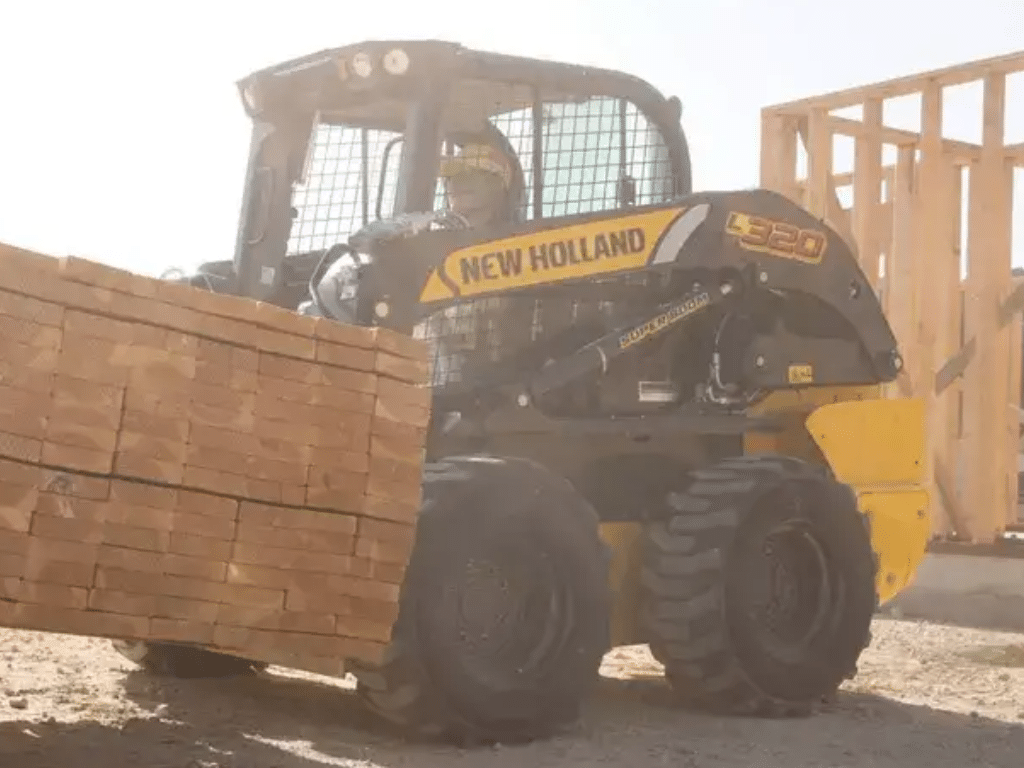
The New Holland 300 Series Skid Steer is arguably the most valuable player in any fleet, large or small. Its compact footprint and zero-turn capability (or near-zero-turn for track loaders) make it the ultimate problem-solver. It’s the first machine on a new residential build, navigating tight property lines to clear and grade, and it’s the last machine to leave, performing final cleanup and landscaping. But its true genius lies in its unmatched versatility. It’s a “base unit” for a staggering array of attachments that can transform it from a digger to a drill, a breaker to a brush cutter, or a trencher to a snow blower. For a landscaper, it’s the one machine that can haul pallets of stone, auger holes for fence posts, and spread topsoil. For a general contractor, it’s the on-site forklift, mini-excavator, and cleanup crew all in one. Its value isn’t in a single function but in its ability to eliminate the need for multiple, less-efficient machines.
- Why New Holland Skid Steers? The 300 Series boasts one of the most stable platforms on the market, with a long wheelbase and a low centre of gravity. This stability doesn’t just improve safety; it inspires operator confidence, allowing them to work faster and more assertively on uneven terrain without the “rocking” feeling common in other machines.
2. The Excavator: The Precision Powerhouse of Earthmoving
When the job requires serious digging, the excavator is the non-negotiable solution. The New Holland E-Series Excavators are the precision powerhouses designed for one primary purpose: moving earth with unmatched control. From the nimble E17C mini-excavator, perfect for trenching utilities in a finished backyard, to the formidable E215E, a foundation-digging and demolition monster, the concept is the same. The 360-degree swing of the upper carriage allows the operator to dig, lift, and place material anywhere within their radius without repositioning the entire machine. This “dig and cast” efficiency is what makes excavators the primary tool for trenching, bulk excavation, demolition, and placing heavy objects like riprap or septic tanks. The advanced hydraulic systems in modern New Holland machines provide a level of “feel” and finesse that allows skilled operators to sculpt a perfect grade or delicately expose a live utility line.
- New Holland’s SMART-ASSIST: Many New Holland excavators are available with the SMART-ASSIST system. This is a machine-control-assist feature that semi-automates functions. For example, it can help an operator maintain a perfectly level trench bottom or a consistent grade on a slope, significantly reducing fatigue and improving accuracy, even for less-experienced operators.
3. The Wheel Loader: The Undisputed King of the Stockpile
Where the skid steer is about versatility and the excavator is about digging, the wheel loader is about volume. The New Holland W-Series Wheel Loaders are built for one thing: moving massive amounts of material as fast as possible. This is the machine for “load and carry” operations. Its primary advantages are capacity, speed, and operator visibility. With an articulated frame, wheel loaders have a tight turning radius relative to their size and a light footprint on the ground, protecting paved or compacted surfaces. Their Z-bar linkage provides incredible breakout force for prying into dense, settled aggregate stockpiles or packed silage. In a landscape supply yard, it’s the machine loading tandem trucks with topsoil in two or three passes. In winter, it’s the ultimate snow-moving machine, clearing large commercial lots. On a farm, it’s the heart of the feed operation.
- The Power of the Cooling Cube: New Holland wheel loaders often feature an innovative “cooling cube” design. This module groups the radiators and coolers in a cube shape instead of stacking them. This unique design ensures that each cooler receives fresh, clean, non-preheated air, maximizing cooling efficiency and reducing the risk of overheating in dusty aggregate yards or high-chaff agricultural environments.
4. The Super Boom® Advantage: New Holland’s Vertical Lift Dominance
Not all skid steers are created equal. New Holland’s patented Super Boom® vertical lift linkage is a genuine game-changer and a primary reason pros choose the brand. A typical “radial lift” machine (which New Holland also offers) swings the load in an arc, which is great for digging and prying at or below ground level. However, a “vertical lift” Super Boom® machine lifts the load in a nearly vertical path. This means the load stays closer to the machine for better stability on its way up, and then at full height, it extends forward, providing best-in-class forward dump height and reach. For any contractor who loads high-sided tandem trucks, feed mixers, or hoppers, this is a non-negotiable feature. It allows the operator to dump the load dead-centre in the truck bed without having to “ram” the truck, saving time, reducing spillage, and improving safety.
- Industry-Leading Visibility: The Super Boom® design also allows for a lower-slung boom. Combined with the 300 Series cab’s thin side screens, massive rear window, and oversized top window, this gives the operator unparalleled lines of sight. They can clearly see the cutting edge of the bucket, the tires, and the load, even when the boom is fully raised.
5. The Compact Track Loader (CTL): The All-Terrain Specialist
The wheeled skid steer is fast and nimble on hard surfaces, but for soft, muddy, or delicate ground, its sibling, the Compact Track Loader (CTL), reigns supreme. The New Holland 300 Series CTLs are built on the same powerful and comfortable chassis but use a dedicated track undercarriage. This system distributes the machine’s weight over a much larger surface area, resulting in incredibly low ground pressure. This “flotation” allows the CTL to work productively in wet spring conditions, on soft loam, or across delicate lawns without churning the ground into a rutted mess. The tracks also provide superior traction for pushing and dozing, making the CTL an exceptional grading machine. For landscapers or excavators working in the variable soils of Southern Ontario, a CTL is often the key to working more days per year.
- A Maintenance-Friendly Design: The New Holland CTL undercarriage is designed for durability and easy cleaning. The simplified design with fewer moving parts (compared to some competitors) and an open, angled frame makes it easier to flush out mud, rocks, and debris, which extends the life of rollers, idlers, and tracks.
6. Wheel Loader Efficiency: More Than Just Brute Force
Modern New Holland wheel loaders are far from simple “scoop and dump” machines; they are intelligent powerhouses designed for maximum fuel economy and uptime. The W-Series loaders achieve this through a combination of smart engineering. Many models use a hydrostatic transmission in smaller units or a 5-speed transmission with torque lock-up in larger models, ensuring the machine is always in the perfect gear for maximum power and efficiency, whether pushing into a pile or travelling across a site. Furthermore, features like ECO Mode, auto-idle, and auto-shutdown dramatically reduce fuel consumption. ECO Mode optimizes engine RPM and hydraulic output for light-duty work, while auto-idle and auto-shutdown (which lowers RPM or turns the engine off after a set period of inactivity) prevent wasteful burning of fuel, directly padding the owner’s bottom line.
- Ride Control for Speed and Comfort: Many New Holland wheel loaders feature “Ride Control,” an automatic system that acts as a shock absorber for the boom. When travelling over rough terrain with a loaded bucket, this system cushions the load, preventing material from spilling and smoothing out the ride for the operator. This allows for faster “load and carry” cycles and reduces operator fatigue.
7. Excavator Hydraulics: The Secret to New Holland’s Finesse
The “power” of an excavator isn’t just its engine horsepower; it’s the intelligence of its hydraulic system. This is where New Holland’s E-Series truly shines. The advanced hydraulic system is designed to provide maximum power when you need it (like breaking ground) and maximum speed when you need that (like swinging to dump). It’s a load-sensing system that automatically adjusts pressure and flow to match the demand, so the engine is never working harder than it has to. The operator can select from multiple work modes (e.g., Heavy, Standard, Light) directly from the in-cab monitor, instantly re-calibrating the machine’s hydraulic response for heavy digging, standard trenching, or delicate finishing work. This intelligent flow management results in faster cycle times, lower fuel consumption, and a smoother, more responsive feel at the joysticks.
- Versatility Through Attachments: The hydraulic system’s versatility is key to an excavator’s ROI. The ability to run attachments like hydraulic hammers, thumbs, augers, or compactors turns the excavator into a multi-function tool. New Holland’s system allows the operator to pre-set the hydraulic flow and pressure for different attachments, so they can be swapped out quickly and operated at their peak, safe performance level with the touch of a button.
8. The “Dig and Load” Synergy: The Ultimate Pro Pairing
On a medium-to-large-scale excavation, no single machine is as efficient as the classic “Dig and Load” combination. This is the pairing of an excavator and a wheel loader working in tandem. The excavator (e.g., a New Holland E145) is the specialist. It sits in one spot and does what it does best: digging the foundation, cutting the site, or loading from a high bank. It creates a stockpile of material. The wheel loader (e.g., a W130) then does its specialty: efficiently shuttling that material from the stockpile to the waiting fleet of dump trucks. The excavator never has to waste time “walking” with a loaded bucket, and the wheel loader never has to waste time digging. This synergistic workflow is the key to maximizing site production, keeping trucks moving, and meeting tight deadlines.
- Right-Sizing Your Fleet: The secret to this synergy is “right-sizing.” A large excavator that can fill a truck in two passes will be sitting idle if it’s paired with a wheel loader that is too small. Conversely, a large wheel loader will be “starved” for material by a small excavator. The experts at Oneida New Holland can analyze a contractor’s average job size and recommend the perfectly matched excavator and wheel loader pair to prevent bottlenecks and optimize workflow.
9. Operator Comfort: The Unspoken Key to Productivity
This might be the most overlooked, yet most critical, feature of all. An uncomfortable operator is a fatigued operator, and a fatigued operator is a slow, error-prone, and unsafe operator. New Holland has poured immense resources into making its cabs the best in the business. The 300 Series skid steer cab is one of the widest in the industry, fully sealed and pressurized to keep out dust and noise. The E-Series excavator cab is a true “office,” with a heated, air-ride seat, ergonomic, low-effort joysticks, and a massive, intuitive LCD monitor. The W-Series wheel loader offers panoramic, distortion-free glass and a quiet environment that allows for all-day operation without exhaustion. This focus on comfort is a direct investment in productivity. It helps retain top-tier operators and ensures they can deliver a full, focused, and efficient 8- or 10-hour day.
- Controls That Adapt to the Operator: New Holland understands that not all operators are the same. Their skid steers and excavators offer customizable controls, allowing operators to switch between ISO or H-patterns and even adjust the responsiveness of the joysticks. This lets operators fine-tune the machine to their personal preference, making them faster, more confident, and more precise.
10. The Oneida New Holland Partnership: Uptime is Local
A world-class machine from New Holland is only half of the equation. The other half—the part that truly matters when a hydraulic line blows at 3:00 PM on a Friday—is the dealer. This is where Oneida New Holland in Caledonia becomes the most critical asset for any local pro. Downtime is a profit-killer. Having a local partner with a massive on-hand parts inventory, a fleet of field service trucks, and factory-trained technicians who can be on your site today is the difference between a minor delay and a multi-day disaster. The team at Oneida New Holland lives and works in this community. They understand the local soil conditions, the demands of the agricultural season, and the pace of the construction market. They don’t just sell you a machine; they build a partnership dedicated to one single goal: keeping you running and making money.
Beyond the Sale: Expert Consultation: The relationship begins long before a sale. The team at Oneida New Holland acts as expert consultants. They will visit your site, analyze your operation, and discuss your business goals. They can provide tailored financing options and recommend the exact machine and attachment package that will deliver the best possible return on your investment, ensuring you don’t over-buy or under-buy.
Conclusion
The “Big 3″—the skid steer, the excavator, and the wheel loader—are not just items on a contractor’s asset list. They are the engine of productivity. Each plays a distinct and irreplaceable role: the skid steer as the ultimate multi-tool, the excavator as the precision digger, and the wheel loader as the high-volume mover.
New Holland has elevated each of these machines with industry-leading innovations, from the unparalleled loading power of the Super Boom® to the fuel-sipping intelligence of the W-Series wheel loaders and the fatigue-reducing comfort of their world-class cabs. For the professional in and around Caledonia, these machines offer a clear competitive advantage. But the equipment itself is only as strong as the support behind it. The true, unbeatable “pro” package is the combination of New Holland’s powerful equipment and the steadfast, local, and expert support of the team at Oneida New Holland.
Call to Action (CTA)
Your fleet is your livelihood. It’s time to power it with the best. Contact the experts at Oneida New Holland today to schedule your demo.
- Address: 634 Fourth Line, Caledonia, ON, N3W2B3
- Call: 905-765-5011
- Website: https://oneidanewholland.com/
Frequently Asked Questions (FAQ)
Q1. What are the “Big 3” machines discussed in the article?
A1. The “Big 3” are the three foundational machines for most professional operations: Skid Steers (for versatility), Excavators (for digging and precision), and Wheel Loaders (for high-volume material handling).
Q2. What is the New Holland Super Boom®?
A2. The Super Boom® is New Holland’s patented vertical lift linkage on its skid steers. Unlike a radial lift, it lifts the load in a near-vertical path, which provides best-in-class forward reach and height. This makes it ideal for loading high-sided trucks and hoppers.
Q3. What is the main difference between a Skid Steer and a Compact Track Loader (CTL)?
A3. They are built on a similar frame, but a skid steer uses wheels, making it fast and agile on hard surfaces. A CTL uses tracks, which gives it much lower ground pressure (“flotation”) and superior traction, making it ideal for working on soft, muddy, or delicate ground.
Q4. How do excavators and wheel loaders work together on a job site?
A4. They create a highly efficient “Dig and Load” synergy. The excavator stays in one place to do the primary digging, creating a stockpile. The wheel loader then efficiently shuttles that material from the stockpile to trucks or other parts of the site, maximizing the productivity of both machines.
Q5. Why is operator comfort so important for productivity?
A5. An uncomfortable operator becomes a-fatigued, slow, and unsafe operator. New Holland’s focus on wide, quiet, and sealed cabs with ergonomic controls and air-ride seats reduces operator fatigue, allowing them to remain productive, focused, and safe for their entire shift.
Q6. Why is a local dealer like Oneida New Holland so important?
A6. Heavy equipment requires fast, reliable support. Downtime costs money. A local dealer like Oneida New Holland provides critical uptime support through a large parts inventory, factory-trained technicians, and fast field service, ensuring that if a machine goes down, it’s back up and running as quickly as possible.